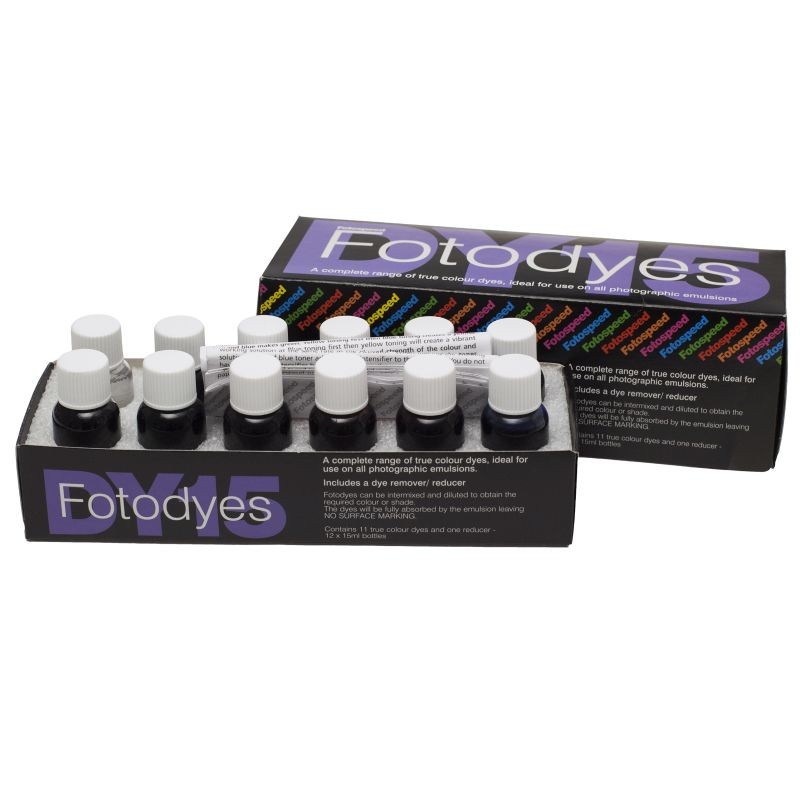
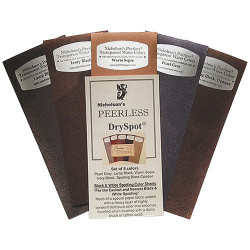
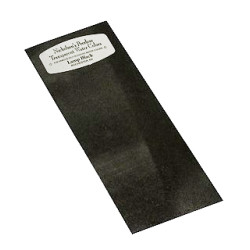
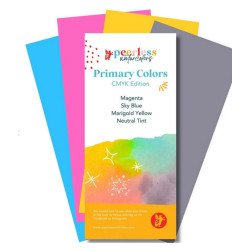
Colours for all kinds of photoemulsions. As true colours are completely absorbed by the emulsion, they leave no trace on the surface.
The set contains 11 different colours and 1 eraser, with which you can correct defects by either partial or complete removal of the paint.
The tinting paints have no negative effect on black and white or colour photographs.
You can freely mix or dilute the individual colours to obtain the desired colour or shade.
The colours are extremely concentrated and care must be taken when diluting, especially at first. We recommend dropping 3 drops of paint into a teaspoon of water. You can monitor the intensity/concentration of the color by adding another drop of color. Test the thinness of the paint on a test paper.
Very rarely are they used undiluted, perhaps only when used on color slides.
-------------------------
Fotospeed DY15 Fotodyes are designed to be used on any photographic emulsion. As true dyes, they are completely absorbed by the emulsion leaving no surface marking.
The dyes come in 11 different colours with one reducer. All the dyes can be fully intermixed and /or diluted to produce any colour or shade required. The dyes are extremely concentrated and caution should initially be exercised when diluting for use. It is very rare to use the dye undiluted except to colour 35mm title slides.
When using for the first time, we suggest you test the strength of colour on scrap prints. As a first test use 3 drops of dye to 1 teaspoon of water. You can then see the effect of stronger colour by adding more drops of dye.
APPLICATION
To obtain the best results prepare the surface by wiping over with a 2% solution of wetting agent such as Fotospeed RA50 but removing surface moisture before applying the dyes.
While this step is not essential it will assist in even dye take up particularly on large areas.
Although these dyes are water soluble, it is difficult to remove them with water since they are absorbed by the emulsion. The dye can be completely removed by using the Reducing Agent in the kit undiluted with a cotton bud. After removing the dye remove the surplus reducer with damp cotton wool before drying the print.
COLOUR PRINTS
To add strength to weak areas use a dilute solution of the required colour. Use a cotton wool swab for large areas but remove surplus dye with slightly damp cotton wool to prevent uneven run down. These dyes are ideal for retouching colour prints as no surface mark will be left by the dye.
BLACK AND WHITE PRINTS
The techniques described for colour prints can be used to hand colour B&W prints. Where toning has been used the Fotodyes can add selective subtle colour to small areas of the print. For retouching untoned black and white prints the Fotospeed DY10 B&W Retouch Kit is more suitable.
COLOUR TRANSPARENCIES
Off colour transparencies will be greatly improved by immersion in a dye bath complimentary colour, but do remove surplus dye before drying.
BLEMISHES
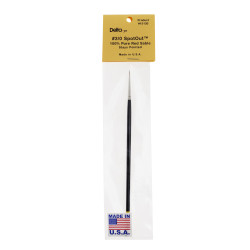
Both prints and transparencies can be spotted-in by stippling with an almost dry brush, be careful not to use too strong a dye.
GENERAL HINTS
Greatest dye take-up will occur when the print or film is not pre-wetted. Nothing will be gained by prolonged immersion, as once the emulsion is thoroughly wetted, it cannot take up more dye. If the colour is not strong enough, repeat the process after drying, maybe with a stronger dye bath. Be sure to dab off surplus dye before drying.
PREMASKING
When dyeing large areas it is better to protect the parts of the image you do not wish to dye. This can best be done by first painting those areas with Fotomask which is a quick drying liquid plastic that easily peels off after dyeing. Fotomask is very useful for dyeing title slides when, by masking and dyeing in sequence, a limitless range of colours can be produces on one slide, but do remember the dye will also be absorbed by the back of the film.
RINSING AND DRYING
If large areas have been dyed whilst others have been kept dry with Fotomask remove the Fotomask before drying and wet the complete print or film to avoid cockling during drying. This step is not necessary if only small areas have been dyed or spotted.
OTHER USES FOR FOTODYES
Undiluted, these dyes are ideal drawing inks of greater purity and brilliance than waterproof inks. Containing no fluorescence, they photograph true to colour. Diluted and applied by airbrush they are used to produce coloured showcards, exhibition signs, etc.
The dyes are in a highly concentrated form, however where greater saturation is required, add 0.5% of Acetic Acid to the dye which will increase saturation by up to 50%.
Do not dilute the black dye. All other colours can be diluted to form pastel colours. All colours can be intermixed to produce a limitless range of colours. Here are a few examples:
50% Yellow + 50% Crimson = Orange
15% Yellow + 85% Crimson = Vermillion
25% Yellow + 75% Cyan = Leaf Green
7% Yellow +93% Cyan = Deep Green
40% Yellow +10% Cyan+ 50% Water = Yellow Green
30% Yellow + 30% Cyan +40% Crimson = Brown
52% Yellow + 20% Cyan +28% Crimson = Burnt Sienna
32% Yellow + 14% Cyan +54% Crimson = Flesh